Security, Privacy, and Quantum (SPQ) Group
Research Interests
Data Security and Privacy, Secure and Intelligent Systems, Quantum Computing, and Post-Quantum Security
Research Thrusts
- Data security and privacy
- Secure and privacy-preserving ML
- Quantum-resistant systems
- Quantum computing
Research Grants
-
Quantum Algorithm Design and Emulation for Seismic Wave Modeling
PI · SAR 700,000 · Saudi Aramco · 2026–2028
-
Novel Passwordless User Authentication System for Quantum Computing Environment
Co-I · SAR 800,000 · PSDSARC · 2025–2028
-
Using Quantum Computing for Reservoir Simulation
PI · SAR 300,000 · Saudi Aramco · 2025–2026
-
Robust, Privacy Preserving Surveillance System for COVID-19
PI · KACST · 2020–2021
-
Design and Implementation of Adaptive Intrusion Management System
PI · DSR, KFUPM · 2020–2021
-
Collaborative Video Streaming
PI · DSR, KFUPM · 2020–2021
Research Projects
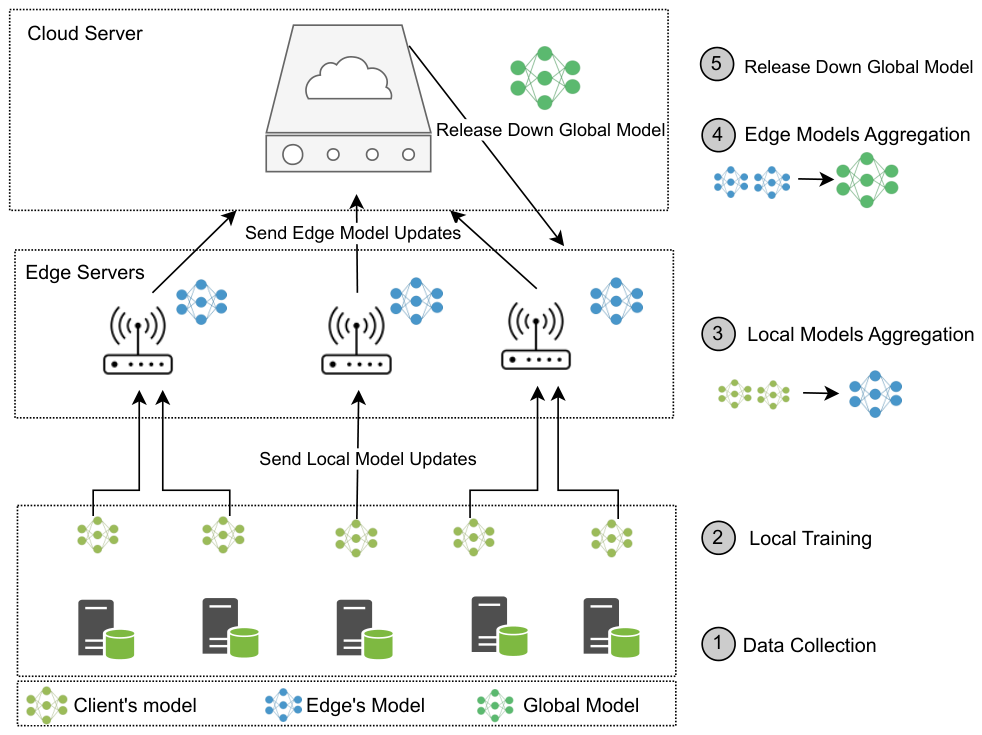
Federated learning keeps raw data on client devices, yet the model updates it exchanges remain an attack surface. This project studies both sides of that surface. On the robustness side, it develops edge-assisted frameworks for early detection of label-flipping (data-poisoning) attacks in client-edge-cloud architectures, including explainable-AI techniques that combine Grad-CAM with clustering to expose malicious client updates, together with mitigation strategies that exclude or mask poisoned gradients. On the privacy side, FedGB, a generator-based federated learning framework built on conditional GANs, shares only the generator with the server to defend against gradient reconstruction attacks while maintaining competitive accuracy.
Publications
Students: Nourah AlOtaibi (PhD), Soha Sandouka (PhD)
Collaborators: Sajjad Mahmood
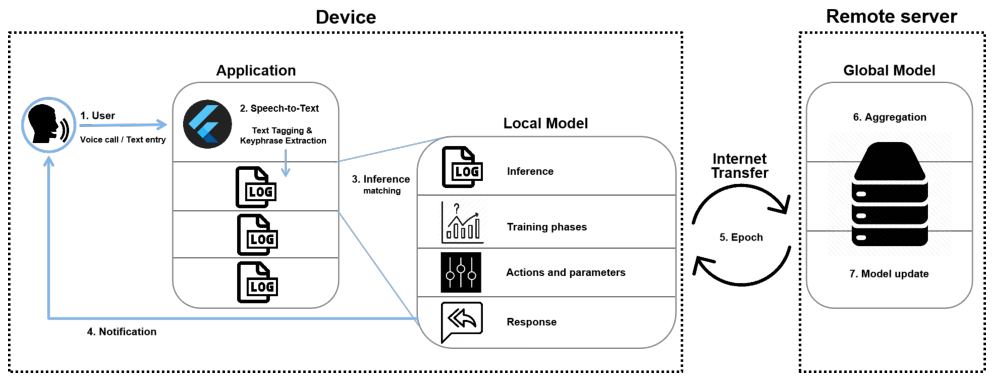
This project brings federated and deep learning to real applications where data is sensitive and compute is constrained. CEFEEL, a communication-efficient federated learning framework for smartphone personal assistants, freezes model parameters that converge early to cut communication and computation without sacrificing accuracy. Companion efforts apply the same efficiency lens to other domains: light-weight file-fragment classifiers built on depthwise separable convolutions enable real-time file carving in digital forensics, and a multi-stage learning framework detects both known and novel (zero-day) attacks in Internet of Medical Things networks with an explicit reject option for unseen behavior.
Publications
-
CEFEEL: Communication-Efficient Federated Learning for Personal Assistant Applications
A. Sa'ad, M. Felemban, A. Tabbakh · IEEE Open Journal of the Computer Society, 2025
-
A Multi-Stage Learning Framework for Detecting Known and Novel Attacks in the Internet of Medical Things
R. Alfageer, M. Ghaleb, W. Aljoby, M. Felemban · IEEE Access, 2026
-
File Fragment Type Classification using Light-Weight Convolutional Neural Networks
M. Felemban, M. Ghaleb, K. Saaim, S. Al-Saleh, A. Almulhem · IEEE Access, 2024
-
Lightweight File Fragments Classification using Depthwise Separable Convolution
K. Saaim, M. Felemban, S. Al-Saleh, A. Al-Mulhem · 37th International Conference on ICT Systems Security and Privacy Protection (IFIP SEC), 2022
Students: Abdulmumin Sa'ad (MSc), Razan Alfageer (MSc), Kunwar Saaim
Collaborators: Abdulaziz Tabbakh, Mustafa Ghaleb, Walid Aljoby, Saleh Al-Saleh, Ahmad Almulhem
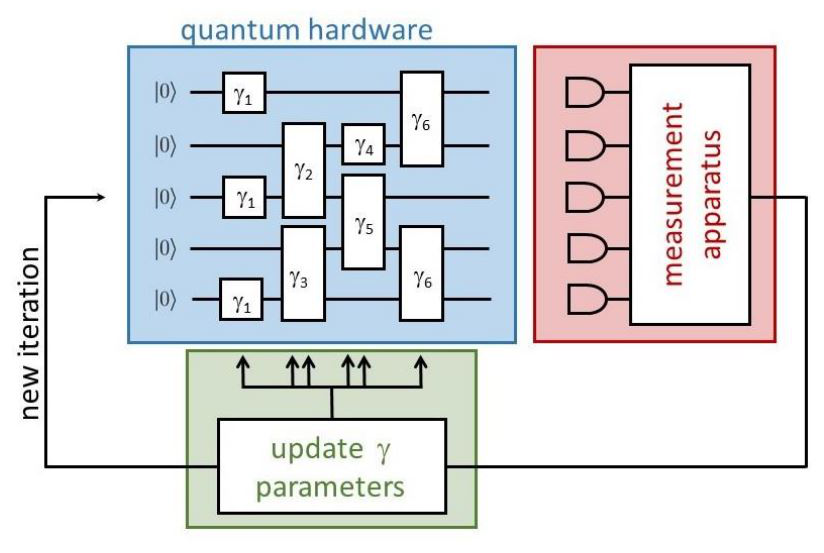
This project investigates what near-term quantum computers can contribute to computationally hard, industrially relevant problems. It evaluates variational quantum algorithms — the Variational Quantum Eigensolver (VQE) and the Quantum Approximate Optimization Algorithm (QAOA) — on combinatorial optimization tasks such as the vehicle routing problem, characterizing the practical limits of today's NISQ devices against classical optimizers. Building on funded work with Saudi Aramco, the group is extending quantum algorithm design and emulation to reservoir simulation and seismic-wave modeling.
Publications
Collaborators: Muhammad Alsaiyari (Saudi Aramco)
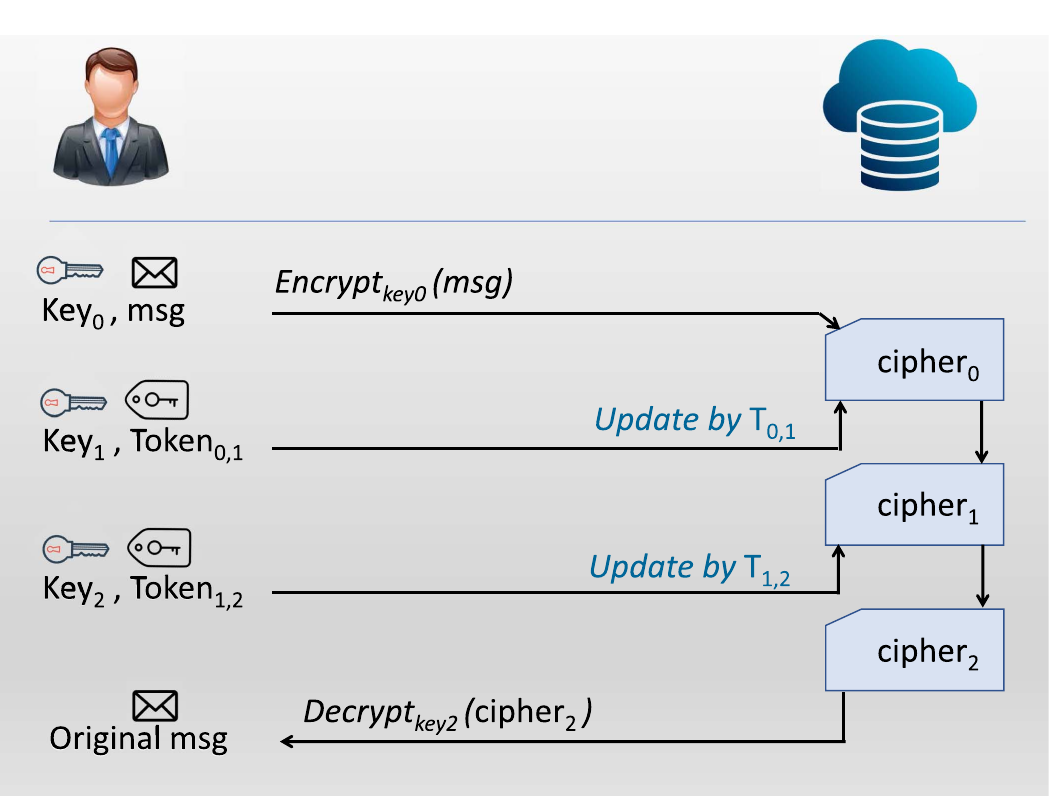
Large-scale quantum computers will break the public-key cryptosystems that secure today's communications, so this project designs cryptographic schemes that remain secure against quantum adversaries. ISNR-PQC, a lattice-based noise-resilient primitive built on the Learning with Errors assumption and NIST FIPS 203, derives reliable cryptographic keys from inherently noisy sources such as biometric measurements. Companion work studies the homomorphic properties of the Kyber and Classic-McEliece KEMs and applies them to post-quantum private set intersection, and proposes a lightweight key encapsulation mechanism based on the Q-problem, a new quantum-resistant hardness assumption. On the key-management side, the project develops an unbounded-depth ElGamal-based asymmetric updatable encryption scheme that rotates keys without ever decrypting the data, along with an encrypted and signed plaintext symmetric cryptosystem that provides confidentiality and authenticity in one construction.
Publications
-
ISNR-PQC: Isometry Noise Resilience Post Quantum Cryptography Primitive
A. A. Al-Saggaf, M. Felemban · Scientific Reports, 2026
-
On the Homomorphic Properties of Kyber and McEliece with Application to Post-Quantum Private Set Intersection
A. A. Abudaqa, K. Alshehri, M. Felemban · Cryptography, 2025
-
Lightweight and Efficient Post Quantum Key Encapsulation Mechanism Based on Q-Problem
M. Kara, K. Karampidis, S. Panagiotakis, M. Hammoudeh, M. Felemban, G. Papadourakis · Electronics, 2025
-
Unbounded Depth ElGamal-Based Asymmetric Updatable Encryption Technique
M. Kara, A. Boukrara, M. Hammoudeh, M. Felemban, S. Guediri · IEEE Open Journal of the Computer Society, 2025
-
An Encrypted and Signed Plaintext Symmetric Cryptosystem
M. Kara, M. Hammoudeh, M. Felemban, K. Karampidis · Computers and Electrical Engineering, 2025
Collaborators: Alawi Al-Saggaf, Mostefa Kara, Mohammad Hammoudeh, Anas Abudaqa, Khaled Alshehri, Konstantinos Karampidis, Spyros Panagiotakis, Giorgos Papadourakis, Ammar Boukrara, Samir Guediri
Previous Projects
-
BeeCast: Design and Implementation of Device-to-Device Collaborative Video Streaming System
[Undergraduate Research, KFUPM]
<Advisor>
(Completed)
-
Adaptive Intrusion Management System (AIMS I): Towards Attack-Resilient DBMS
[Northrop Grumman]
<Research Assistant>
(Completed)
-
Adaptive Intrusion Management System (AIMS II): Developing Benchmarking for Malicious Transaction Workload
[Northrop Grumman]
<Research Assistant>
(Completed)
-
Adaptive Threat Management (ATM) for Cyber-Physical Systems
[Northrop Grumman]
<Research Assistant>
(Completed)
-
Optimized Robust Video Streaming in Cellular Network
<Researcher>
(Completed)
-
Risk-Resilient Resource Management in Cloud Computing
<Research Assistant>
(Completed)
-
Security and Privacy Preserving Data Mining and Management for Distributed Domains
[NSF TC: Medium]
<Research Assistant>
(Completed)
-
CoralSense: Underwater Acoustic Network
[KACST-NSTIP]
<PhD student>
(Completed)